An extension request succeeds or fails on two things: whether the course allows it, and how early you ask. The wording matters less than students think. This guide shows what real courses’ policies say, then gives two emails you can adapt.
We are the engineering team at DoMyProgrammingHomework.io. The policies below are quoted from five university programming courses.
Read the late policy before you write anything
Policies differ far more than students expect. Here are five introductory programming courses.
| Course | Built-in flexibility | Extensions |
|---|---|---|
| Harvard CS50 | “a semester-long allowance of 72 hours” for late problem sets | “Extensions beyond this lateness policy are not ordinarily granted.” |
| MIT 6.0001 | “two late days that they can use on problem sets” | “We do not grant any extensions.” |
| Stanford CS106A | A “grace period” of 48 hours on each assignment | The head TA arranges “extra time for extraordinary circumstances” |
| UC Berkeley CS 61A | Projects within 48 hours get 75 percent of the score | Requests up to 24 hours, made before the deadline, “will be approved” |
| Carnegie Mellon 15-112 | Grace days: “a penalty-free homework extension” | “extensions are not generally granted for homeworks” |
Three lessons from that table.
You may not need to ask. Stanford says of its grace period: “You do not need any permission to use the grace period. Just turn the work in.” Use the days the course already gives you before you spend goodwill on a request.
Some courses will say no, whatever you write. At MIT the answer is in the syllabus. In that case your options are the late days, a partial submission, or the emergency route below.
Who you ask matters. At Harvard, “The only individuals authorized to grant extensions are the course’s heads.” At Stanford the TA “handles homework extensions”. Writing to the wrong person costs you a day.
Ask before the deadline, not after
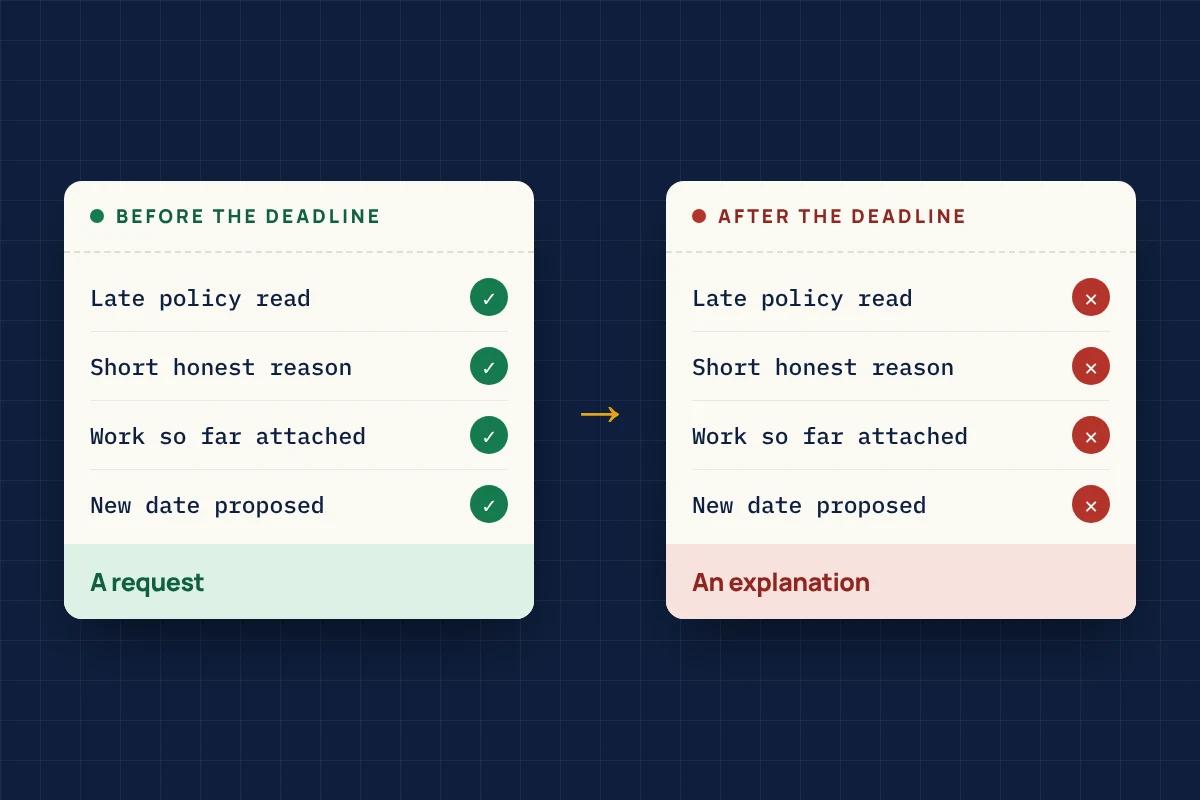
Berkeley’s rule shows why timing matters: a request has to be made “before the original deadline”. A request sent an hour after the deadline is a different thing: you are no longer asking for more time, you are explaining a missed deadline.
The best moment is as soon as you know. Two days ahead reads as planning. Ten minutes ahead reads as panic.
What counts as a good reason
Carnegie Mellon’s syllabus is unusually direct about this. Accepted: “Serious Illness or Medical Emergencies.” and “Family or Personal Emergencies.” Not accepted: “Busy week (academically or otherwise)”.
That is one course, and others are more flexible. The pattern is common, though: things outside your control count, and workload usually doesn’t. If your honest reason is a heavy week, say so plainly and ask for a short extension. Don’t invent an emergency. An instructor can ask for proof, and a false reason can turn a late assignment into an integrity problem.
How to write the email
The University of North Carolina’s Writing Center gives advice that fits this exactly:
- “Briefly state your purpose for writing in the very beginning of your message.”
- “Be sure to provide the reader with some context.”
- “Finally, state the desired outcome at the end of your message.”
- “Re-read messages before you send them.”
Keep it short. Your instructor is reading dozens of these.
Subject: CS 201, Assignment 4: extension request

Dear Professor Lee,

I am writing to ask for a two-day extension on Assignment 4, which is
due this Friday at 11:59 pm.

I have been ill since Tuesday and have not been able to work. I can
send a note from the health center if that helps.

I have finished parts 1 and 2 and attached them. Could I submit the
complete assignment by Sunday at 11:59 pm?

Thank you for considering this.

Maya Chen
CS 201, Section BSubject: CS 201, Assignment 4: extension request
Dear Professor Lee,
I am writing to ask for a 24-hour extension on Assignment 4, due this
Friday at 11:59 pm.
I underestimated part 3 and I am behind. I have read the late policy
and have no late days left.
Parts 1 and 2 are done and attached. With one more day I can finish
part 3 and test it properly. If an extension is not possible, I will
submit what I have by the deadline.
Thank you for your time.
Maya Chen
CS 201, Section BBoth emails do the same five things: name the course and assignment, ask in the first line, give a short true reason, show the work so far, and propose a specific date. Replace the names and details with your own. The names above are made up.
If it is a real emergency
A serious illness or a family emergency is bigger than one assignment, and many universities have an office for it. At MIT, Student Support Services helps with “plans and communication with faculty when extenuating circumstances get in the way” of coursework.
Know what such an office can and can’t do. The University of Illinois says of its absence letters: they “do not excuse students from class nor ensure that make-up work will be permitted”. The instructor still decides. Illinois also sets a time limit: letters must be requested “within 10 business days of their return to class.” Find your own university’s office and its deadline.
If you have a documented disability, extra time may already be something you are entitled to. Your university’s disability services office arranges that, so talk to them early in the term.
If a few days won’t be enough
When the problem is the rest of the term and not one deadline, ask about an incomplete. Arizona State describes it as a mark given “when you are otherwise doing acceptable work but are unable to complete the course because of illness or other conditions beyond your control.” It is for students who were passing. If you are failing, the choice is different, and we compare the options in withdraw from a class or fail it.
If the answer is no
- Submit what you have. Partial credit beats zero. At Berkeley a late project still earns 75 percent within 48 hours.
- Make it run. If the course grades by running your code, a smaller program that runs can earn points that a larger broken one can’t.
- Ask what matters most. One line to a TA can tell you which part carries the points.
We can also help with the assignment itself. Send it to us, and a senior engineer writes or fixes it, tests it and explains the code. On our debug my code page, a single bug or error message is typically $45–$70, usually the same day.
Related: programming assignment help and coding project help. If the code is what keeps you late every week, see is coding hard?
Questions students ask
How do I ask a professor for an extension?
Read the late policy, then email the person the syllabus names before the deadline. State the request in the first line, give a short honest reason, attach the work you have done, and propose a specific new date. Keep it to a few sentences.
What is a good reason for an extension?
Things outside your control, such as illness or a family emergency. Carnegie Mellon’s introductory programming course lists serious illness and family or personal emergencies as accepted reasons and a busy week as not accepted. Other courses are more flexible, so read your own syllabus.
Can I ask for an extension after the deadline?
You can ask, but it is much weaker. UC Berkeley’s CS 61A, for example, requires extension requests before the original deadline. After it, check the late policy: some courses still give partial credit for a day or two.
Do professors usually give extensions?
It depends on the course. Among five introductory programming courses we read, MIT’s says it does not grant any extensions, Harvard’s says they are not ordinarily granted, and Berkeley’s approves requests of up to 24 hours made before the deadline. Many courses give late days in place of extensions.
What are late days?
A fixed allowance for handing work in late without penalty or permission. MIT’s introductory Python course gives two late days for problem sets, Harvard’s CS50 gives 72 hours across the term, and Stanford’s CS106A gives a 48-hour grace period on each assignment.
Should I make up an excuse to get an extension?
No. A plain honest request for a short extension is safer than an invented emergency. A false reason can turn a late assignment into an academic integrity matter, which is far more serious than a late penalty.
Sources
- Harvard CS50 syllabus, Fall 2025
- MIT OpenCourseWare: 6.0001 syllabus
- Stanford CS106A syllabus (winter 2021 handout)
- UC Berkeley CS 61A syllabus
- Carnegie Mellon 15-112 syllabus
- University of North Carolina Writing Center: effective email communication
- MIT Student Support Services
- University of Illinois, Office of the Dean of Students: absence letters
- Arizona State University registrar: grades
The US Department of Education’s page on disability accommodations would not load when we wrote this, so it is not quoted.
Upload the prompt and see a predicted budget in under a minute. A senior engineer confirms the final price.