Students who were good at school math are often the most surprised. Calculus rewarded you for running a known procedure quickly. Discrete math gives you a statement and asks why it must be true. No procedure produces the answer.
We are the engineering team at DoMyProgrammingHomework.io. This guide explains what the course is, why it feels different, and a weekly routine that works. The course details are quoted from MIT, Stanford and UC Berkeley.
What discrete math covers
It is the mathematics of separate things: true and false, whole numbers, sets, networks. MIT lists its topics as “formal logic notation, proof methods; induction, well-ordering; sets, relations; elementary graph theory”, along with “permutations and combinations, counting principles; discrete probability.”
| Topic | What you do | Where you meet it again |
|---|---|---|
| Logic | Work with and, or, not and implies | Every if statement |
| Proofs | Show a statement must be true | Arguing that an algorithm is correct |
| Induction | Prove something for every whole number | Recursion and loops |
| Sets and relations | Describe collections and how items relate | Databases |
| Graphs | Study points joined by lines | Networks, maps, scheduling |
| Counting | Count arrangements without listing them | How long a program takes |
| Probability | Reason about chance | Machine learning, randomized algorithms |
The right-hand column is why the course is required. Data structures and algorithms both lean on it.
Why it feels harder than the math you know
There is no procedure to follow. A derivative has rules. A proof has to be invented each time, from definitions.
Definitions carry all the weight. One guide to studying mathematics puts it well: “Definitions are not a good place to practice your speed reading.” If you are vague about what “relation” means, every problem that uses the word is closed to you.
It takes time you can’t compress. Stanford tells its students: “The problem sets in this class take time”. A proof that takes three hours of thinking does not get shorter because it is due at midnight.
Exams weigh heavily. Stanford says “the exams are three-quarters of your grade in this course!” At UC Berkeley, “the bulk of your grade is based on your exam performance”. Homework is where you learn, and the exam is where it counts, so copying an answer to a problem set costs you later.
Being stuck is part of it. Stanford’s guidance says of the struggle: “This is a normal part of learning mathematics”.
One proof, taken slowly
The claim: the sum 1 + 2 + ... + n equals n(n + 1) / 2, for every whole number n from 1 up.
- Check the first caseFor n = 1 the sum is 1, and the formula gives 1 × 2 / 2 = 1. They match.
- Assume it works for some nSuppose 1 + 2 + ... + n = n(n + 1) / 2 for one particular n.
- Show the next case followsAdd n + 1 to both sides. The right side becomes n(n + 1) / 2 + (n + 1), which is (n + 1)(n + 2) / 2. That is the formula with n + 1 in place of n.
The first case is true, and each case forces the next. So the claim holds for every n.
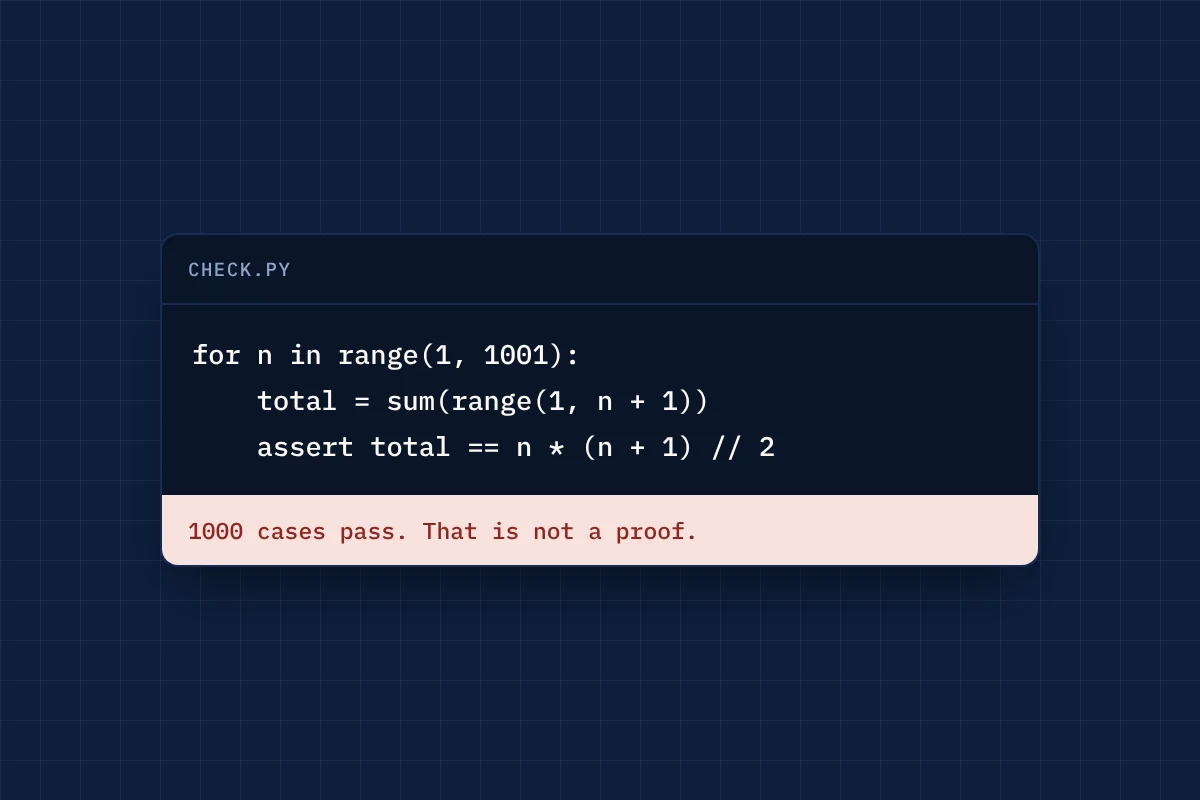
It is tempting to just test it. We did:
for n in range(1, 1001):
    assert sum(range(1, n + 1)) == n * (n + 1) // 2
print("the formula holds for n = 1 to 1000")
That difference is the whole course. A program checks the cases you gave it. A proof covers the cases nobody will ever run. Programmers need both, which is why a computer science degree teaches both.
Four habits that sink students
- Memorizing proofs. The same study guide warns: “it is not a good idea to try to memorize the proof of a theorem.” Learn why each step is allowed. The exam will change the problem.
- Starting the night before. Advice from a Stanford student, quoted by the course: “Start the problem sets early so you have time to think through your proofs.”
- Skimming definitions. “To understand a definition you should make up your own examples”. If you can’t give an example, you don’t have it yet.
- Working entirely alone. MIT’s course says: “Collaborate with other students on the homework.” It also sets the limit: “your writeup must be entirely your own.”
A weekly routine that works
- Read the problem set the day it comes outYou don’t need to solve anything. Your mind works on problems you have seen.
- Rewrite each definition with your own exampleOne example that fits and one that doesn’t.
- Attempt every problem alone firstEven a failed attempt shows you where the gap is.
- Then talk to peopleOffice hours, recitation, a study group. MIT’s advice is blunt: “Attend recitation!”
- Write the final version yourselfFrom a blank page, without notes. If you can’t, you have not understood it yet.
Stanford adds one more, and it is the one students skip: “We strongly recommend taking some time after each lecture to review what was covered”.
How it connects to the code
If discrete math feels pointless, look at what comes next. Recursion is induction that runs. A loop is correct for the same reason an inductive proof is. Running time is a counting problem. Seeing those links makes data structures and algorithms feel less foreign when you reach them.
For how the courses compare, see is computer science hard? If the code side is your trouble, see is coding hard?
When an assignment won’t wait
We work on the programming side of these courses: algorithms homework with code, proofs of correctness and complexity analysis. Send us the assignment, and a senior engineer solves it and explains each step so you can follow the argument. Typical prices are on our algorithms homework help page and in our price guide.
Related: programming assignment help. If the course has gone badly already, see what happens if you fail a class in college.
Questions students ask
Is discrete math hard?
For many computer science students, yes. It is usually the first course built on proofs, and a proof has to be worked out from definitions each time. MIT describes its course as emphasizing mathematical definitions and proofs. The difficulty is a new skill, not a lack of ability, and it eases with weekly practice.
Is discrete math harder than calculus?
It is hard in a different way. Calculus mostly asks you to apply known procedures. Discrete math asks you to show why a statement must be true, with no procedure to follow. Students who were strong at calculation often find that adjustment the hardest part.
Why do computer science students have to take discrete math?
Because later courses depend on it. Induction is the reasoning behind recursion and loops, counting is how running time is measured, graphs model networks, and logic sits under every condition in a program.
How do I study for discrete math?
Start each problem set the day it is released, rewrite every definition with your own example, try each problem alone before discussing it, and write the final proof yourself from a blank page. Stanford recommends reviewing what was covered after each lecture, and warns that the problem sets take time.
Should I memorize proofs for the exam?
No. A widely used guide to studying mathematics says it is not a good idea to try to memorize the proof of a theorem. Understand why each step is allowed, because the exam will ask a problem you have not seen.
Is it normal to be stuck on a proof for hours?
Yes. Stanford’s guidance to its own students calls the struggle a normal part of learning mathematics, and says the problem sets in the course take time. Being stuck is how the skill is built.
Sources
- MIT OpenCourseWare: 6.042J Mathematics for Computer Science and its syllabus
- Stanford CS103: Mathematical Foundations of Computing and how to succeed in CS103
- UC Berkeley CS 70: course policies
- Lawrence Neff Stout, Illinois Wesleyan University: How to Study Mathematics
Upload the prompt and see a predicted budget in under a minute. A senior engineer confirms the final price.