That is the general picture. The details are set by your own university, and they differ. So this guide does two things. It tells you what to look up, with the federal rules and real university policies quoted word for word. And it covers what is different for computer science students, where one failed course can hold up a chain of others.
We are the engineering team at DoMyProgrammingHomework.io. We are not academic advisors. Use this to prepare for the conversation with yours.
What an F does
| What it affects | What happens | Who to ask |
|---|---|---|
| Your GPA | The course counts with zero grade points | The registrar’s GPA rules |
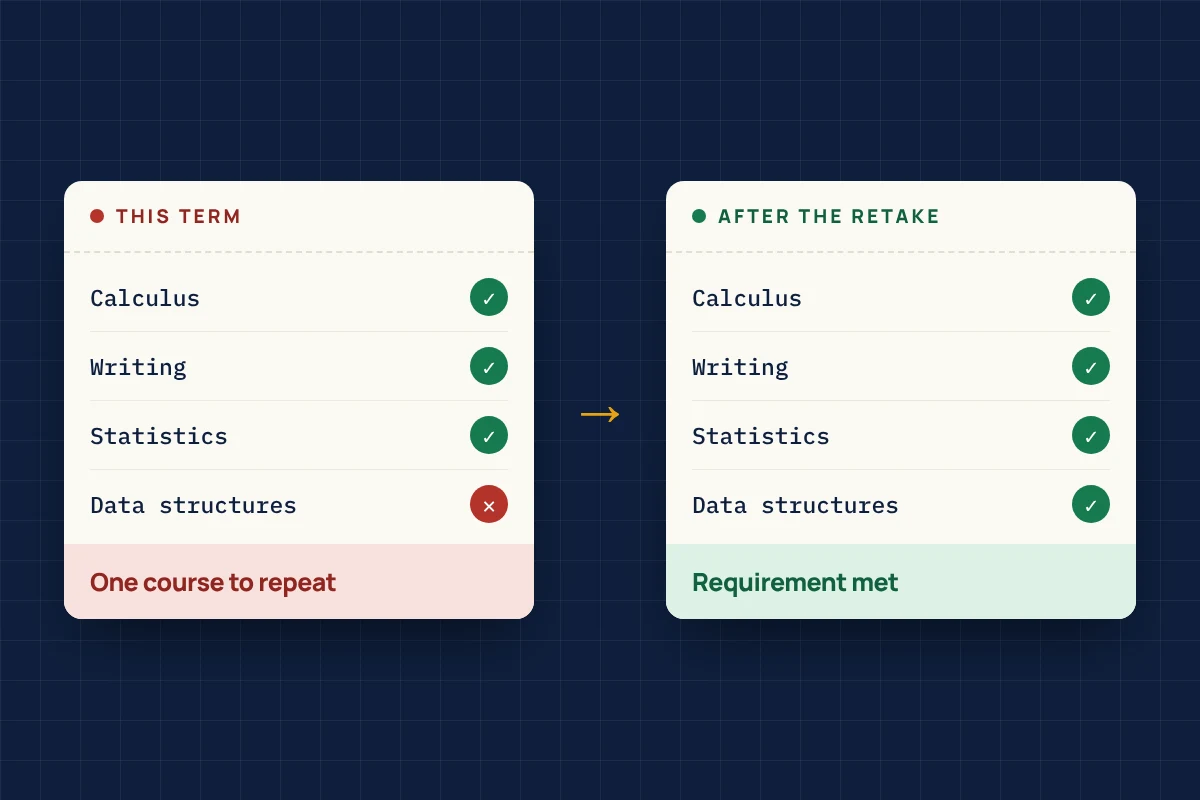
| The requirement | A failed required course has to be repeated | Your degree plan or advisor |
| Courses that follow | You may not be able to take the next course yet | Your department |
| Financial aid | Your GPA and your pace of completion are both checked | The financial aid office |
| Your standing | A low enough GPA brings a warning or probation | Your advisor |
Your GPA, with the arithmetic
A GPA is a weighted average. Arizona State University’s registrar gives the method: “Multiply the grade point value by the number of semester hours for which the course was taken to determine the honor points.” Then: “Divide the honor points by the net hours to calculate the GPA.”
An A is worth 4 points and an F is worth 0. Here is one term of four 3-credit courses.
| Grades | Points earned | Credits | GPA |
|---|---|---|---|
| A, B, B and an F | 12 + 9 + 9 + 0 = 30 | 12 | 2.50 |
| A, B, B and a C | 12 + 9 + 9 + 6 = 36 | 12 | 3.00 |
| B, B, B and an F | 9 + 9 + 9 + 0 = 27 | 12 | 2.25 |
One F in a term of otherwise good grades pulls the number down hard, and it is still a number you can recover from. The damage shrinks with every term you add after it.
In computer science, the chain matters more than the grade
Computer science courses build on each other. If you fail a course that others require, your problem is the calendar as much as the GPA: the next course has to wait until you pass this one.
Some departments also ask for more than a bare pass in their core courses. The University of Washington’s Allen School, for example, requires “Fundamental courses for CS or CE with a minimum 2.0 grade”. Look up your own department’s rule. In a program like that, a D can leave you repeating the course just as an F would.
We wrote about which courses students find hardest, and why, in is computer science hard?
Retaking: does the new grade replace the F?
It can, within limits, and it depends on the university. Arizona State’s policy is one real example:
- “Undergraduate courses in which grades of ”D“ or ”E“ (including EU, EN, and XE) are received may be repeated only once.” (ASU calls its failing grade E.)
- “To be eligible for the deletion of ”D“ or ”E“ grades from calculations of the GPA, the course must be repeated at ASU.”
So at that university you get one repeat, and the replacement only works if you retake the course there. Other universities average the two grades, cap the number of replacements, or keep both on the record. Search your catalog for “repeat” or “grade replacement” and read the exact wording before you plan around it.
Using the first row of the table above: replace the F with a B on the retake, under a policy like ASU’s, and that term’s GPA moves from 2.50 to 3.25.
Financial aid
This is the part to check first, because it has deadlines.
To keep federal student aid in the United States, you have to make what the regulations call satisfactory academic progress. Each school writes its own policy, and federal rules say what that policy must contain:
- A grade measure: “The policy specifies the grade point average (GPA) that a student must achieve at each evaluation”.
- A pace measure: “the pace, measured at each evaluation, at which a student must progress through his or her educational program”. A failed course is one you attempted and did not complete, so expect it to count against your pace. Your school’s policy says exactly how.
- A time limit: “a period that is no longer than 150 percent of the published length of the educational program”.
- How bad terms are treated: the policy must say “how a student’s GPA and pace of completion are affected by course incompletes, withdrawals, or repetitions”.
If you fall short, a school may first give you a warning term. The regulation defines it: “Financial aid warning means a status assigned to a student who fails to make satisfactory academic progress”. Schools may also allow an appeal, and the regulation names the kinds of reasons that count: “The death of a relative, an injury or illness of the student, or other special circumstances”.
One piece of good news. Retaking the course does not by itself cost you aid. Arizona State’s registrar puts it plainly: “A student may receive federal financial aid when repeating a course that was previously failed.”
Scholarships and private loans have their own rules. Read the award letter.
If you have not failed yet: withdraw, take an incomplete, or finish
If the term is still running, you may have three choices. They are not available at every point in the term, so check dates today.
| Option | Effect on GPA | What shows on your record | Watch out for |
|---|---|---|---|
| Finish and fail | Counts as zero | The failing grade | The GPA hit |
| Withdraw | None, at the schools we checked | A W, or at UT Austin a Q | The deadline, aid pace, credit load |
| Incomplete | None until it is resolved | An I, for a limited time | You must already be passing |
Withdrawing. Arizona State says: “The grade of 'W' has no impact on your GPA.” It still shows: a withdrawal “will result in a grade of 'W' on your official transcript”. The University of Texas at Austin marks a dropped course with a Q, and says of such symbols: “Courses in which these symbols are recorded are not included in the grade point average.”
A withdrawal is not free. It is a course you attempted and did not complete, so it can count against the pace your aid depends on. It can also drop you below full time.
An incomplete. This is for a student who was doing fine and then could not finish, not for one who is failing. Arizona State: an “I” is given “when you are otherwise doing acceptable work”. The University of California, Berkeley, tells instructors they may assign one “if your student’s work in a course has been of passing quality”.
International students, read this before you drop anything. The US Department of Homeland Security says: “F-1 undergraduate students at a college or university must take at least 12 credit hours per term.” And: “You cannot drop below a full course of study unless your DSO approves it and updates your student record in SEVIS.” Talk to your international student office first.
What to do this week
- Work out the numberAdd up the points still available. What do you need on the remaining work to pass? Sometimes the answer is better than you fear.
- Write to the instructorAsk what can still be submitted, and whether anything late will be accepted. Ask early in the week, not the night before.
- Find the withdrawal deadlineIt is on the academic calendar. Know the date even if you plan to stay.
- See your advisor and the aid officeBefore you withdraw, ask what it does to your aid, your standing and your graduation date.
- Put your hours where the points areOne large programming project is often worth more than several quizzes. Start with whatever carries the most weight.
If the F is already on your record
In our experience, three reasons sit behind most failed programming courses. The student understood the lectures and could not turn them into code. They started the big project too late. Or their code worked on their laptop and failed the course’s grader. The last one has its own guide: why code works locally but fails the autograder.
If the course has left you doubting the whole degree, read “I hate computer science” before you decide anything.
When one assignment decides the grade
Sometimes the whole course comes down to a project due in a few days. That is where we can help. Send us the assignment. A senior engineer writes or fixes it, tests it and explains the code line by line, so you understand what you are handing in. We can’t promise you a grade, and nobody honestly can.
See programming assignment help, data structures homework help and algorithms homework help. For one stubborn bug, see debug my code. Typical prices are in our price guide.
Questions students ask
What happens if you fail a class in college?
The F counts as zero in your GPA and the course does not satisfy its requirement, so a required course has to be taken again. Your financial aid can be affected, because federal rules tie aid to your GPA and to the share of attempted credits you complete. One failed class does not end your degree.
Does retaking a class replace the F?
At some universities it can, with limits. Arizona State, for example, allows a failed undergraduate course to be repeated only once, and removes the old grade from the GPA only if the course is repeated at that university. Other schools average the grades or cap replacements, so read your own catalog.
Will I lose financial aid if I fail a class?
Not automatically. Federal aid depends on satisfactory academic progress, which your school measures by GPA, by pace of completion and by a time limit of 150 percent of the program’s length. One F counts against the first two. A school may start with a warning term and may allow an appeal.
Is it better to withdraw or fail?
A withdrawal usually does not count in your GPA, and a fail counts as zero, so withdrawing protects the GPA. It still appears on your transcript, it can count against the pace your aid depends on, and it can take you below full time. Ask your advisor and the aid office before the deadline.
Can you still graduate if you fail a class?
Yes. You repeat the course if it is required, and you need to meet your school’s minimum GPA. The University of Washington’s computer science school, for example, requires a minimum cumulative GPA of 2.00. Failing may move your graduation date if the course leads to others.
Can international students drop a class they are failing?
Only with care. The US Department of Homeland Security says F-1 undergraduates must take at least 12 credit hours per term, and cannot drop below a full course of study unless their designated school official approves it. Speak to the international student office before withdrawing.
Sources
- Code of Federal Regulations, 34 CFR 668.34: satisfactory academic progress
- Arizona State University registrar: grades, repeating courses and GPA and drop, add and withdraw
- The University of Texas at Austin: grades
- University of Washington, Allen School: continuation policy
- University of California, Berkeley registrar: incomplete grades
- US Department of Homeland Security, Study in the States: full course of study
The federal student aid site and several other university catalogs would not load when we wrote this, so they are not quoted. The GPA examples are our own arithmetic.
Upload the prompt and see a predicted budget in under a minute. A senior engineer confirms the final price.