Most answers to this question give one confident number. Nobody has that number. How long it takes depends on what “learn” means to you and how many hours a week you put in.
We are the engineering team at DoMyProgrammingHomework.io. We don’t have a statistic on how long learners take, and we don’t trust the sites that quote one. What does exist is how long real courses are designed to take. So this guide starts there.
The numbers that exist
| Yardstick | What the source says | Total |
|---|---|---|
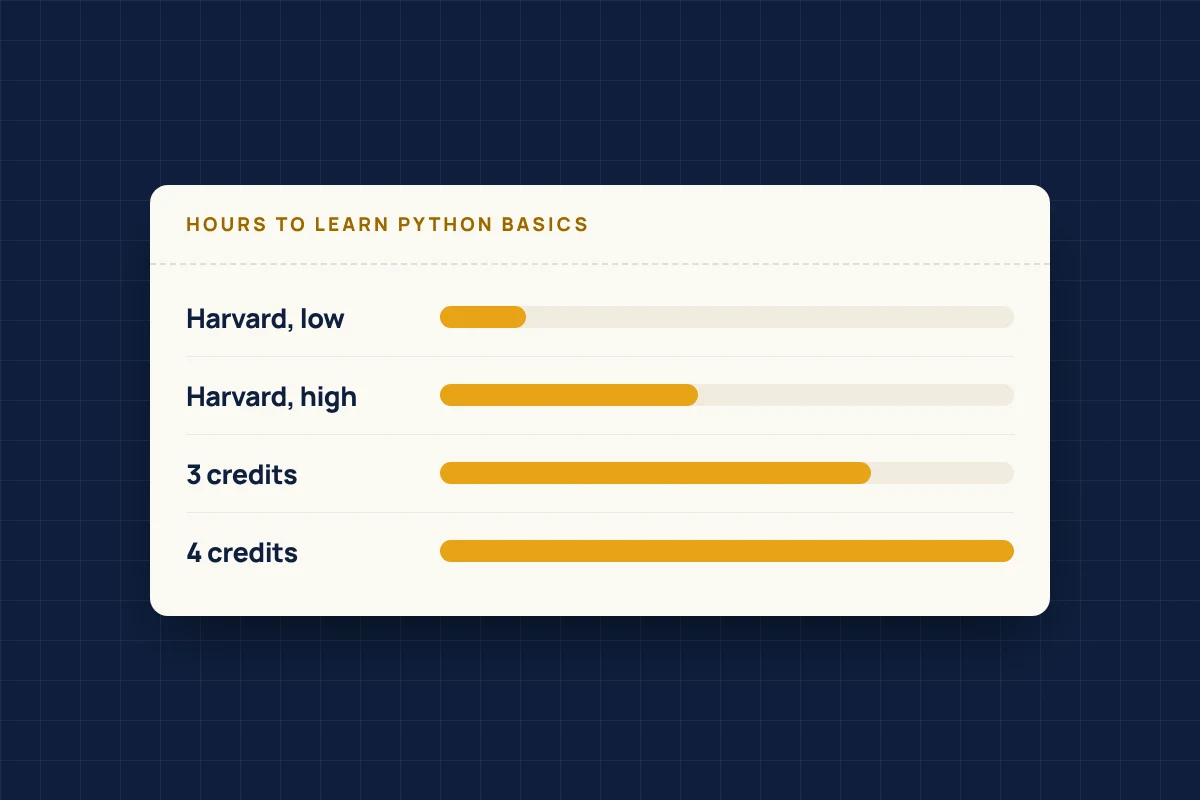
| Harvard: CS50’s Introduction to Programming with Python | “9 weeks long”, “3 - 9 hours per week”, self-paced | 27 to 81 hours |
| MIT 6.0001: Introduction to Computer Science and Programming in Python | “This is a half-semester course.” Two one-hour lectures and one recitation a week, 12 lectures in all | Not stated |
| A 3-credit college course | One hour in class and at least two hours outside it each week, for about 15 weeks | About 135 hours |
| A 4-credit college course | The same rule, with four credits | About 180 hours |
The totals for Harvard and for the credit courses are our own arithmetic from the published figures. Nine weeks at 3 hours is 27 hours, and at 9 hours it is 81.
The college figure comes from the United States government’s definition of a credit hour: “One hour of classroom or direct faculty instruction and a minimum of two hours of out-of-class student work each week”, “for approximately fifteen weeks”. That is 45 hours for each credit. It is a minimum, and a programming project can take more.
Both university courses are built for beginners. Harvard’s is “designed for students with or without prior programming experience who’d like to learn Python specifically”. MIT’s is “intended for students with little or no programming experience”.
One detail differs between Harvard’s own pages. The course site describes “ten weeks of material”, and the course listing says 9 weeks. We used the listing, because it is the page that gives hours.
What “learn Python” means: four stages
“I know Python” can mean four different things. The first three are what the two university courses cover.
- Write small scriptsVariables, conditions, loops and functions. These are the first three units of Harvard’s course.
- Write programs that do a jobFiles, exceptions, libraries and tests. At this stage you can clean up a data file or automate a boring task.
- Organize larger codeClasses and objects, and knowing why one approach is faster than another. MIT’s course ends with classes, program efficiency, searching and sorting.
- Use Python in a fieldpandas for data, Flask or Django for the web, scikit-learn or PyTorch for machine learning. Each one is a subject of its own.
MIT states the goal of the first three stages well. Its course wants students to “feel confident of their ability to write small programs that allow them to accomplish useful goals”.
Here is what stage 2 looks like. This program reads a file of scores and reports the average. We ran it on Python 3.13.
import csv

total = 0
count = 0
with open("scores.csv") as f:
    for row in csv.DictReader(f):
        total += int(row["score"])
        count += 1

print("students:", count)
print("average:", round(total / count, 1))
If you can write that without looking anything up, you have the basics.
Stage 4 has no official number, and we won’t invent one. Our own service pages give a sense of scale. On our Python homework help page, a pandas data analysis notebook is typically a 2–4 day order, and a Django or Flask web app is 5–7 days. On our machine learning homework help page, a PyTorch deep learning project is 4–7 days. Those are times for engineers who already know the tools. Learning the tools comes first, and it takes a course of its own.
How many weeks at your pace
Hours matter more than weeks. This table turns the totals above into weeks for five study paces. It is plain division, rounded up to whole weeks.
| Your pace | 27 hours (Harvard, low) | 81 hours (Harvard, high) | 135 hours (3 credits) | 180 hours (4 credits) |
|---|---|---|---|---|
| 3 hours a week | 9 weeks | 27 weeks | 45 weeks | 60 weeks |
| 5 hours a week | 6 weeks | 17 weeks | 27 weeks | 36 weeks |
| 10 hours a week | 3 weeks | 9 weeks | 14 weeks | 18 weeks |
| 15 hours a week | 2 weeks | 6 weeks | 9 weeks | 12 weeks |
| 20 hours a week | 2 weeks | 5 weeks | 7 weeks | 9 weeks |
So “the basics in a month” is realistic at 10 hours a week or more. “Comfortable in a semester” is what a college course is designed for.
What makes it faster or slower
You already program in another language. Then you are not learning to program, only learning Python. The official Python tutorial is written for exactly that reader. It is “designed for programmers that are new to the Python language, not beginners who are new to programming”.
You write code every time you study. Reading about loops is not the same as writing one. Type the examples. Change them. Break them on purpose and read what Python says.
You study often. Five one-hour sessions beat one five-hour session, because you forget less between them. That is our experience as engineers, not a measured result.
You have something to build. A course assignment or a small project of your own gives you a reason to finish.
You expect errors. A real share of your time will go on reading error messages. That is not a sign you are slow. It is the work. Our posts on the errors beginners meet first can save you an evening: IndexError: list index out of range, KeyError and ModuleNotFoundError.
Is Python easier than other first languages?
Python’s own documentation says so, and gives reasons. Its FAQ asks “Is Python a good language for beginning programmers?” and answers “Yes.” It adds: “Students may be better served by learning Python as their first language.”
The tutorial opens with “Python is an easy to learn, powerful programming language.” It also says “Programs written in Python are typically much shorter than equivalent C, C++, or Java programs”. Shorter programs mean less to type and less to get wrong.
One caution. The language is the easy part. What takes time is learning to break a problem into exact steps, and that is the same work in Python, Java or C. If you want the wider picture, we wrote an honest answer to is computer science hard? If your course uses Java, see what Java is used for.
A 10-week plan
This plan follows the order of the ten units in Harvard’s course. The topics are Harvard’s. The practice tasks are our suggestions.
| Week | Topic | Write this |
|---|---|---|
| 1 | Functions and variables | A program that asks for your name and greets you |
| 2 | Conditionals | A grade calculator: a mark goes in, a letter comes out |
| 3 | Loops | A times table, then a number guessing game |
| 4 | Exceptions | The same game, surviving bad input |
| 5 | Libraries | Dice with the random module, then one library you install yourself |
| 6 | Unit tests | Tests for your grade calculator |
| 7 | File input and output | Read a file of scores and print the average |
| 8 | Regular expressions | Check that an email address has the right shape |
| 9 | Classes and objects | A Student class with a method that reports a grade |
| 10 | Everything else | One small project of your own |
At 5 hours a week this plan is 50 hours, inside Harvard’s range. It is a plan, not a promise. Some topics will take you longer than a week. Give classes and objects extra time if you need it.
How long until you can get a job with Python?
There is no official number for this either. What the official source does say is about education. The US Bureau of Labor Statistics writes: “Software developers, quality assurance analysts, and testers typically need a bachelor’s degree”.
So treat Python as one skill among several. A degree also covers data structures, algorithms, databases and working on larger code with other people. Python is often the language those subjects are taught in, which is one more reason to learn it well. When you get to applying, our post on how to list programming skills on a resume may help.
When an assignment won’t wait
Sometimes the deadline arrives before the skill does. Send us the assignment. A senior engineer writes it, tests it and explains the code line by line, so you can learn from it and explain it yourself. On our Python homework help page, intro scripts and functions are typically $45–$90, delivered in 1–2 days.
Related: programming assignment help and debug my code. For what help usually costs, see our price guide. If your code runs on your machine and fails the course grader, see why code works locally but fails the autograder.
Questions about learning Python
Can I learn Python in a month?
You can learn the basics in a month if you put in the hours. Harvard lists its introductory Python course at 9 weeks and 3 to 9 hours a week, which is 27 to 81 hours. At 10 hours a week, a month is 40 hours, which is inside that range. A specialty such as data analysis or web development takes longer.
Is Python hard to learn if I have never programmed?
Python is one of the gentler places to start. Its own documentation answers yes to whether it is a good language for beginning programmers, and both Harvard and MIT teach introductory courses in it for students with little or no experience. The harder part is learning to break a problem into exact steps, which is the same in any language.
How many hours a day should I study Python?
There is no official figure. An hour a day is 7 hours a week, which sits inside the 3 to 9 hours a week on Harvard’s course listing. A 3-credit college course is designed as about 9 hours a week under the federal definition of a credit hour. Regular short sessions work better than one long one.
Can I get a job after learning Python?
Python is one skill among several that employers look for. The US Bureau of Labor Statistics says software developers typically need a bachelor’s degree in computer and information technology or a related field. We know of no official figure for how long self-taught learners take to be hired, so we don’t give one.
Should I learn Python or Java first?
If your course has chosen, learn the language your course uses. If the choice is yours, Python’s documentation makes the case for Python: it says students may be better served by learning Python as their first language, and that Python programs are typically much shorter than equivalent Java programs.
How long does a college Python course take?
Under the US federal definition, one credit is one hour in class plus at least two hours of work outside it each week, for about 15 weeks. That makes a 3-credit course about 135 hours and a 4-credit course about 180 hours. MIT teaches its introductory Python course as a half-semester course.
Sources
- Harvard: CS50’s Introduction to Programming with Python and its course listing
- MIT OpenCourseWare: 6.0001 Introduction to Computer Science and Programming in Python and its syllabus
- Code of Federal Regulations, 34 CFR 600.2: definition of a credit hour
- The Python tutorial and its first chapter
- Python general FAQ
- US Bureau of Labor Statistics: software developers, quality assurance analysts and testers
Upload the prompt and see a predicted budget in under a minute. A senior engineer confirms the final price.