“Hard” is not one thing. A first programming course is hard in a different way from an operating systems course, and a student who struggles in one often does fine in the other. So this guide answers the question course by course.
We are the engineering team at DoMyProgrammingHomework.io. We don’t have a statistic that ranks majors by difficulty, and we don’t trust the ones that claim to. What we can give you is what each course asks of you, how big its assignments are, and what the official sources say about the workload and the jobs at the end.
Why it feels harder than other subjects
1. Everything builds on what came before. Data structures assumes you can already write loops and functions without thinking. Algorithms assumes data structures. If one layer is shaky, every layer above it feels impossible. In many other subjects you can have a bad month and recover in the next unit. Here the gap follows you.
2. The feedback is all or nothing. An essay that is 80 percent right earns most of the marks. A program that is 80 percent right doesn’t compile, or fails the tests. Many courses grade your code with an automatic grader that compares output exactly. That is honest feedback, and it is also brutal. Our guide to why code works locally but fails the autograder covers the usual surprises.
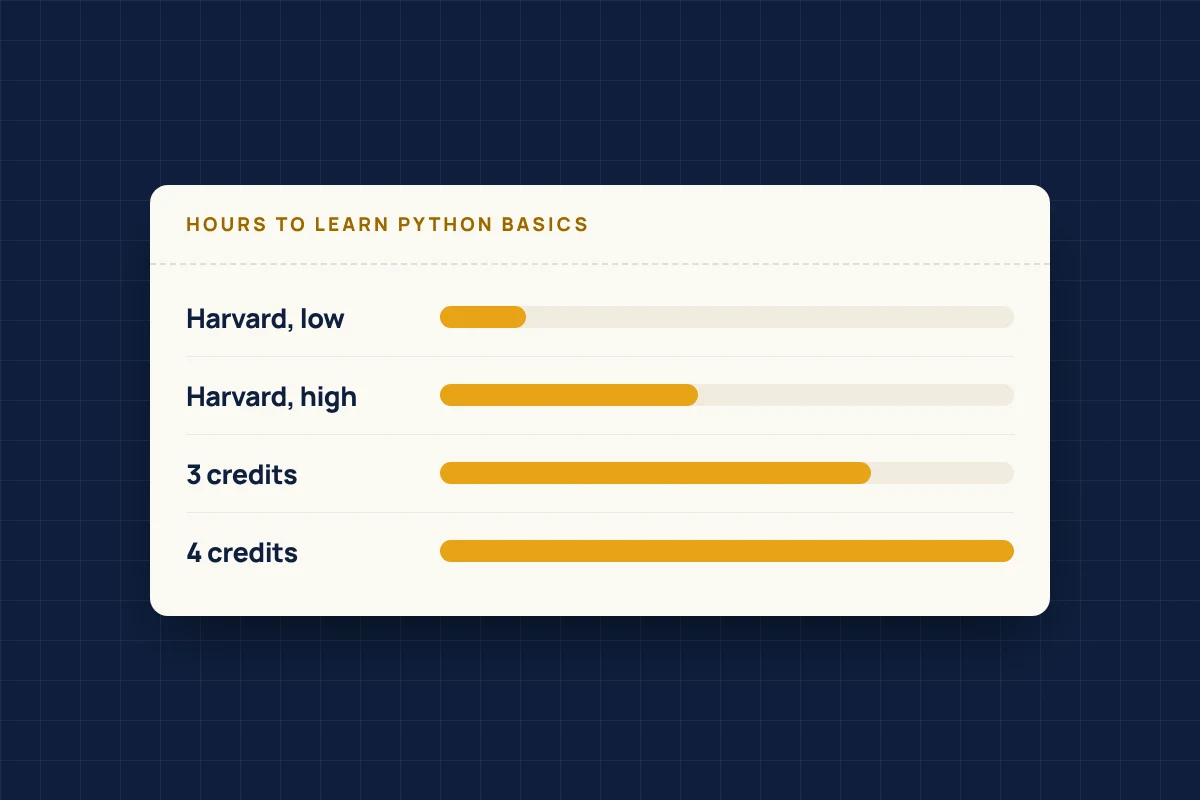
3. The hours are real. The United States government defines a credit hour like this: “One hour of classroom or direct faculty instruction and a minimum of two hours of out-of-class student work each week”. By that definition a 4-credit course means at least 12 hours a week, and a programming project can take more than the minimum. MIT’s registrar puts it this way: “One MIT unit is approximately equal to 14 hours of work per term.” A 12-unit subject is then about 168 hours.
4. There is math, and it is a different kind. The curriculum guidelines published by ACM, IEEE-CS and AAAI list “Mathematical and Statistical Foundations” as one of their 17 knowledge areas. A good part of that math is logic and proof, which is a different skill from calculation. Students who were strong at school math sometimes find that the hardest adjustment.
How hard is each course?
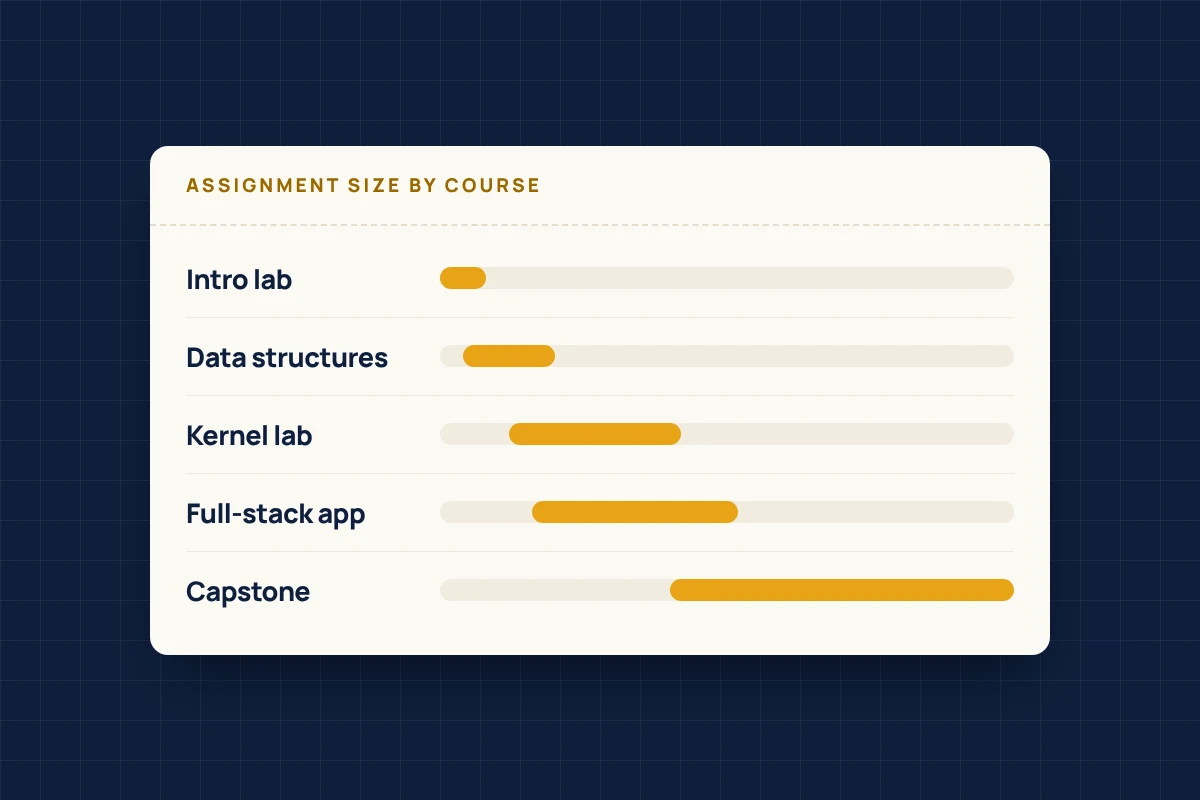
The last column is a real figure. It is how long our engineers usually take to deliver a typical assignment of that kind, copied from our service pages. It gives you a sense of scale.
| Course | What makes it hard | A typical assignment | Our usual delivery time |
|---|---|---|---|
| Intro programming | Thinking in exact steps. Syntax errors. Output that must match exactly. | Intro lab (1–2 files) | 1–2 days |
| Data structures | Pointers and references. Recursion. Edge cases such as an empty list. | BST, AVL or red-black tree | 2–4 days |
| Algorithms | Proofs. Choosing an approach that is fast enough, not just correct. | DP problem set (3–5 problems) | 2–3 days |
| Systems programming in C | Memory you manage yourself. Bugs that don’t crash where they happen. | Malloc / allocator lab | 4–6 days |
| Operating systems | Concurrency. Reading a large code base you didn’t write. | xv6 or Pintos kernel lab | 5–8 days |
| Databases | Thinking in sets, not loops. Design choices with no single right answer. | Full database application | 5–8 days |
| Web development | Many tools at once: front end, back end, database, deployment. | Full-stack app with auth | 6–10 days |
| Machine learning | Linear algebra and statistics. Results that vary from run to run. | PyTorch deep learning project | 4–7 days |
| Capstone | Planning months of work. Working in a team. | Full undergraduate capstone | 6–12 weeks |
Two things stand out. A first-year lab is a day or two of work for an engineer, and a capstone is weeks. And the reason a course is hard changes: early courses are hard because the ideas are new, later ones because the projects are large.
The courses where students get stuck
Intro programming
The ideas are small. The difficulty is precision. A missing bracket stops everything, and error messages read like a foreign language at first. This passes. Learning to read errors is the skill, and it gets fast. We wrote guides to three common ones: IndexError: list index out of range in Python, cannot find symbol in Java, and the segmentation fault in C. See also Python homework help and Java homework help.
Data structures
This is often the first course that feels like a wall. You build lists, trees and hash tables from scratch, and your code is tested on cases you didn’t think of. Recursion and pointers arrive at the same time. If you learn one habit here, make it testing the empty case and the single-item case before anything else. More on our data structures homework help page.
Algorithms
The programs are short. The thinking is long. You are asked to prove that a method is correct and to show how its running time grows. A solution that works on small inputs can fail outright on the large ones the grader uses. See algorithms homework help.
Operating systems and systems programming
You work in C, close to the machine, inside thousands of lines someone else wrote. Bugs depend on timing and may not show up on every run. These are the largest assignments most students meet before the capstone. See operating systems homework help and C assignment help.
Can you do it with no experience?
Yes. Harvard’s CS50 says so directly: it is for students “with or without prior programming experience”. Its syllabus adds: “Two thirds of CS50 students have never taken CS before.” Students who arrive with experience usually find the first term easier. That head start matters less once the material is new to everyone. If Python is your first language, we worked out how long it takes to learn Python from the hours real courses are designed for.
What you do need is time, and a tolerance for being stuck. Being stuck is the normal state of programming, for professionals too. The students who do well are rarely the ones who are never stuck. They are the ones who start early enough that being stuck for a day doesn’t sink the assignment.
Is it worth the effort?
The official numbers say the work pays off. The US Bureau of Labor Statistics reports that the median annual wage for computer and information technology occupations “was $109,470 in May 2025”, against $50,980 for all occupations. It projects about 280,000 openings each year, on average, from 2025 to 2035.
For software developers, quality assurance analysts and testers, the same source projects 10 percent growth from 2025 to 2035, which it calls “much faster than the average for all occupations”. The typical entry-level education it lists is a bachelor’s degree.
Those are medians and projections for the United States. They are not a promise about any one graduate. If you are choosing a direction within the field, our posts on what Java does and getting hired in the Java industry are a place to start.
What makes it easier
- Start the day it is assignedRead the whole assignment and write the first ten lines. Problems you have seen early get solved in the background.
- Read the error before you search for itThe message usually names the file, the line and the kind of mistake. Reading it is faster than guessing.
- Test small, and test the edgesRun your code after every few lines. Try an empty input and a single item before the full example.
- Fix the layer underneathIf loops still take effort, data structures will hurt. Go back and practice the earlier material until it is automatic.
- Go to office hours with a specific question“It doesn’t work” gets you little. “Line 40 returns null when the list has one item” gets you an answer.
- Explain your code out loudIf you can’t say what each part does, you don’t understand it yet. Better to find that out before the exam.
When you are stuck on an assignment
Sometimes the deadline arrives before the understanding does. That is what our service is for. A senior engineer writes a reference solution to your assignment, with tests and a written explanation of every decision, so you can see how the problem is solved and explain it yourself.
Related: programming assignment help, debug my code and our guide to programming homework help prices.
Questions about studying computer science
Is computer science hard for beginners?
The first course is demanding, mostly because programs must be exactly right before they run at all. It does not require experience. Harvard’s introductory course is designed for students with or without prior programming experience, and says two thirds of its students have never taken computer science before.
How many hours a week does a computer science course take?
The US federal definition of a credit hour is one hour of class plus a minimum of two hours of work outside class each week. By that definition a 4-credit course is at least 12 hours a week. Programming projects often take more than the minimum in the weeks they are due.
Is computer science a lot of math?
There is a real math component. The ACM, IEEE-CS and AAAI curriculum guidelines include Mathematical and Statistical Foundations as one of 17 knowledge areas. Much of it is logic and proof, which feels different from the calculation most students did at school.
What is the hardest class in computer science?
It depends on the student, and there is no official ranking. The courses with the largest assignments are usually operating systems and the capstone. On our service pages a kernel lab usually takes our engineers 5 to 8 days to deliver, and a full undergraduate capstone 6 to 12 weeks.
Can I study computer science if I have never coded?
Yes. Introductory courses are built for it. You will probably need more time in the first term than classmates who have programmed before. That gap narrows once the material is new to everyone.
Is a computer science degree worth it?
The official figures are strong. The US Bureau of Labor Statistics reports a median annual wage of 109,470 dollars for computer and information technology occupations in May 2025, against 50,980 dollars for all occupations, and projects about 280,000 openings a year from 2025 to 2035.
Sources
- Code of Federal Regulations, 34 CFR 600.2: definition of a credit hour
- MIT Registrar: subject levels and credit
- Harvard CS50 syllabus, Fall 2025
- ACM, IEEE-CS and AAAI Computer Science Curricula 2023: knowledge areas
- US Bureau of Labor Statistics: computer and information technology occupations and software developers, quality assurance analysts and testers
Upload the prompt and see a predicted budget in under a minute. A senior engineer confirms the final price.