You are not the only one typing this. Ahrefs, a search data tool, estimates that “i hate computer science” is searched about 2,400 times a month in the United States alone.
We are the engineering team at DoMyProgrammingHomework.io. Students often come to us at this point in a term, so we hear what sits behind the sentence. This guide helps you work out which version is yours, and what to do about it this week.
You are in large company
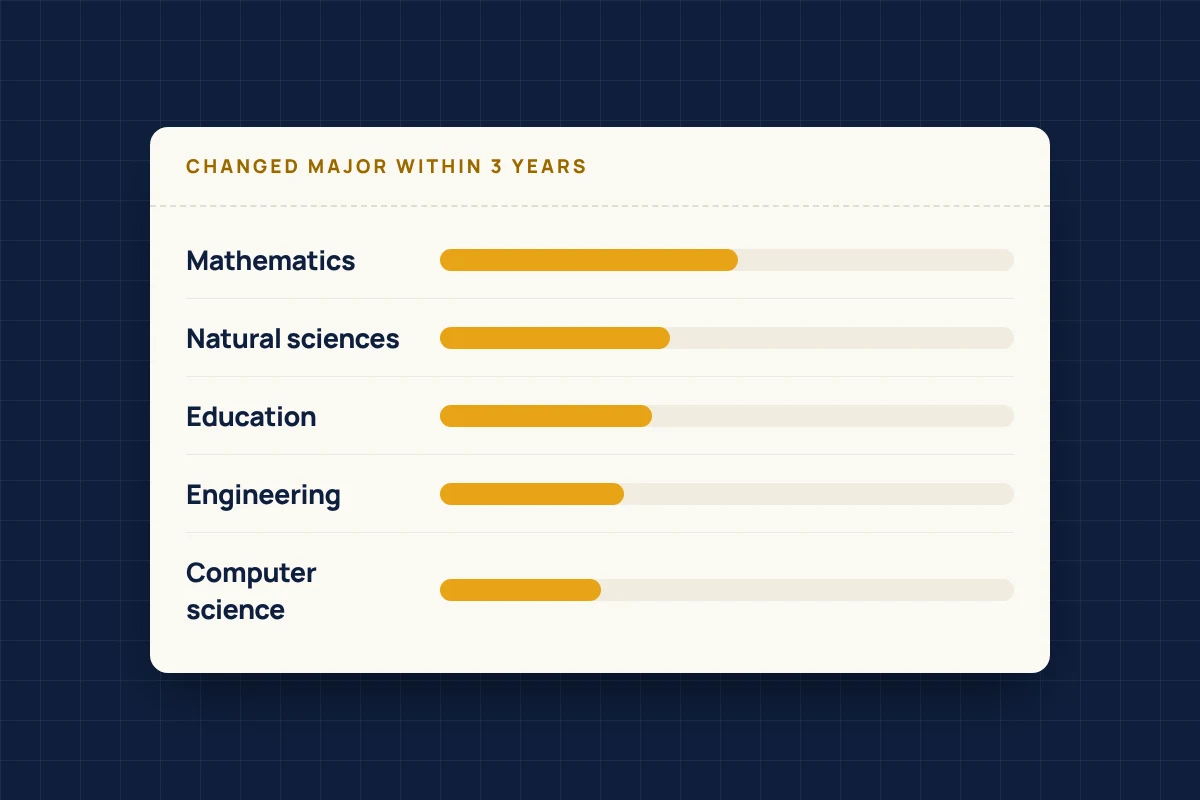
The National Center for Education Statistics followed students who started college in 2011–12. It found that “about 30 percent of undergraduates in associate’s and bachelor’s degree programs who had declared a major had changed their major at least once” within three years. For bachelor’s students it was about one third.
| Field they started in | Changed major |
|---|---|
| Mathematics | 52 percent |
| Natural sciences | 40 percent |
| Education | 37 percent |
| Humanities | 36 percent |
| Engineering and engineering technology | 32 percent |
| Computer and information sciences | 28 percent |
Two things follow. Doubting your major is ordinary. And 72 percent of the students who started in computer and information sciences had not changed major three years later.
Which kind of hate is it?
“I hate computer science” covers at least five different problems. Read the left column and find your sentence.
| What you would say | What it usually means | Start here |
|---|---|---|
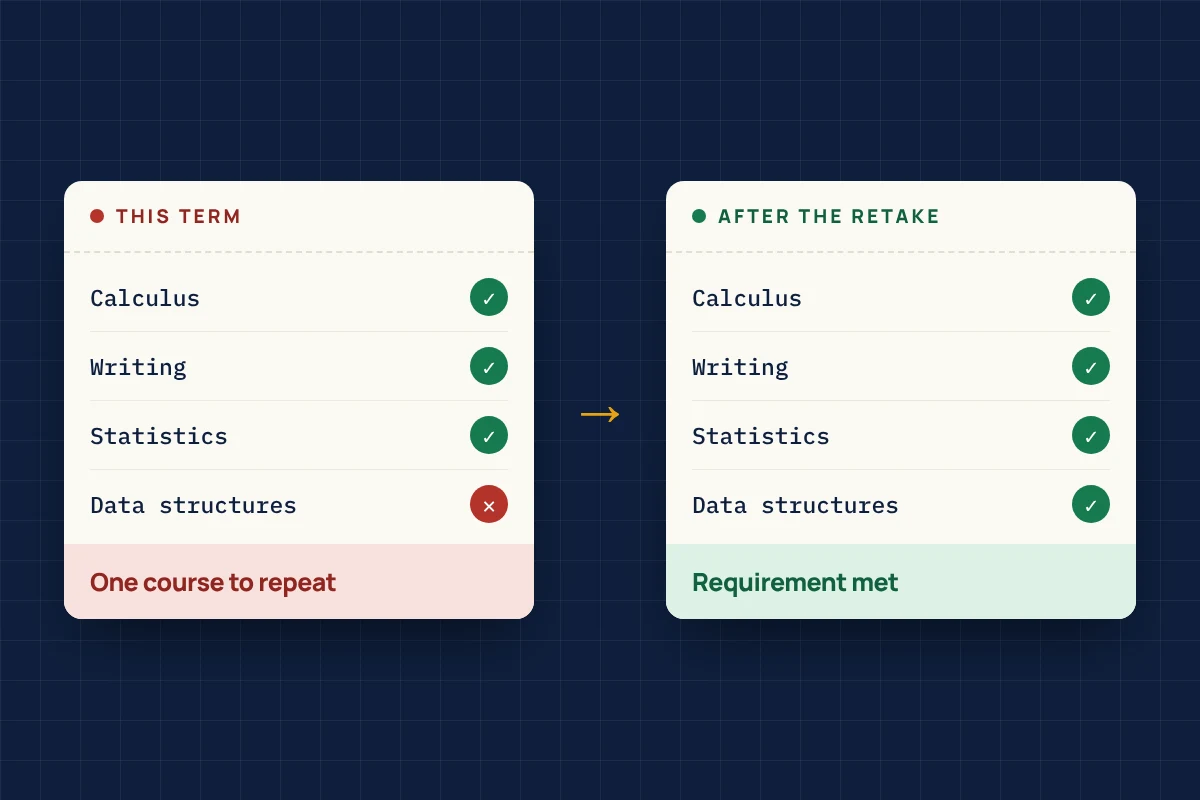
| “This one course is destroying me” | One course is the problem, not the field | Look at what comes after it |
| “I follow the lecture and then can’t write the code” | You need practice writing, not more explaining | Small programs, every day |
| “Everyone else gets it” | You are comparing your inside with their outside | Measure against where you began |
| “I am tired all the time” | The workload has gone past what you can carry | Cut the load, and talk to someone |
| “I don’t want to code for a living” | You have a narrow picture of the field | Look at the other jobs |
“This one course is destroying me”
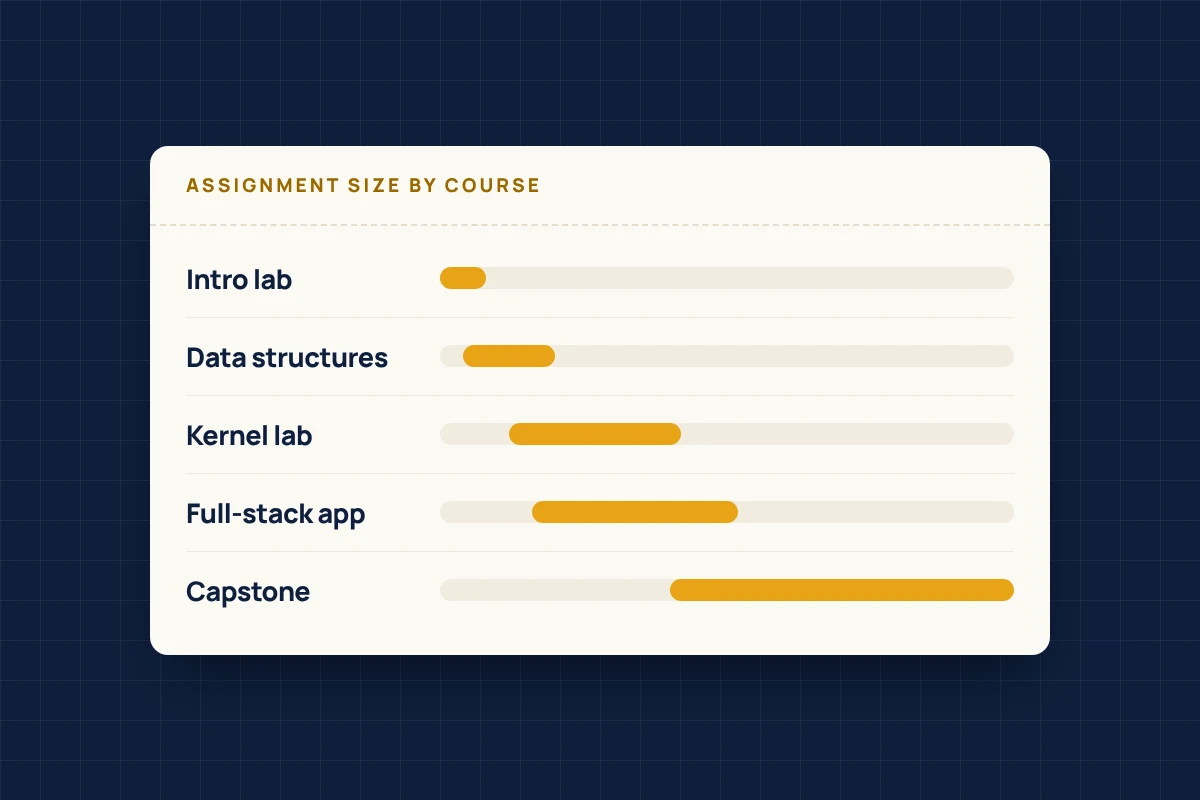
Data structures and discrete math are the courses students on forums most often call a wall. A wall in one course says little about the next one, because the courses are hard in different ways. We went through them one by one in is computer science hard? Read what your next two terms contain before you judge the degree by this one.
“I follow the lecture and then can’t write the code”
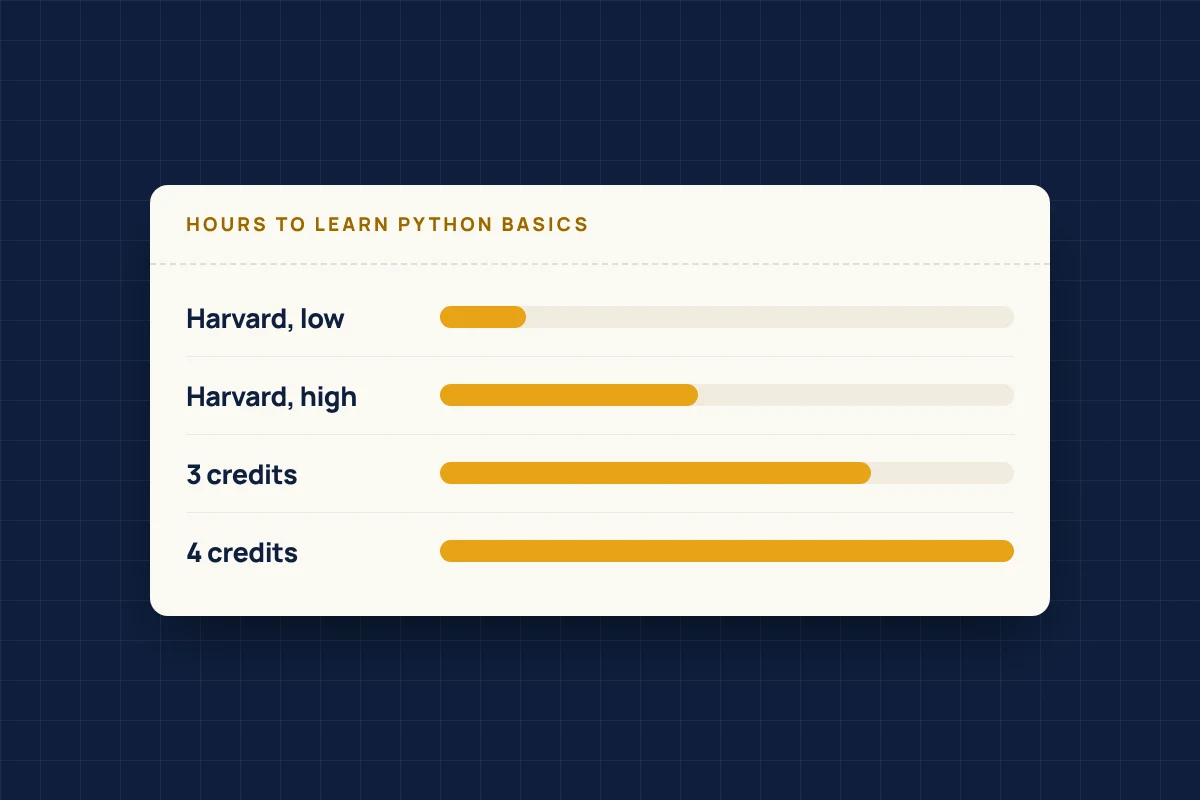
Students say this a lot, on forums and to us, and it is not a sign that you lack talent. Understanding an explanation and producing code are two different skills. The second one only grows by writing code, getting an error, and fixing it. Start smaller than your assignment: a ten-line program that does one thing. Our guide to how long it takes to learn Python has a week-by-week list of small programs to write.
“Everyone else gets it”
The classmates who look fluent usually started earlier. Harvard’s introductory course says so about its own students: “Two thirds of CS50 students have never taken CS before.” It also tells them what to measure: “what ultimately matters in this course is not so much where you end up relative to your classmates but where you end up relative to yourself when you began.”
“I am tired all the time”
Programming assignments take long, unpredictable hours, and several can land in one week. If you are exhausted, the first thing to change is the load: fewer credits next term, an earlier start on each project, or help with the assignment that is sinking you.
If the tiredness comes with hopelessness that does not lift, treat that as a health matter, not a study problem. See the last section.
“I don’t want to code for a living”
Then it helps to know how wide the field is. The next section is for you.
Computer science is more than programming
The curriculum guidelines published by ACM, IEEE-CS and AAAI divide the subject into 17 knowledge areas. Programming is one part of it. The list also includes Human-Computer Interaction, Security, Data Management, Networking and Communication, Artificial Intelligence, and Society, Ethics, and the Profession.
The jobs are just as varied. These are from the US Bureau of Labor Statistics.
| Occupation | Typical entry-level education | Median pay, 2025 |
|---|---|---|
| Software developers, quality assurance analysts and testers | Bachelor’s degree | $134,040 |
| Information security analysts | Bachelor’s degree | $129,180 |
| Database administrators and architects | Bachelor’s degree | $126,760 |
| Computer systems analysts | Bachelor’s degree | $105,850 |
| Web developers and digital designers | Bachelor’s degree | $99,520 |
Not all of these are about writing programs all day. The Bureau describes two of them like this: “Computer systems analysts study an organization’s current computer systems and design ways to improve efficiency.” And: “Information security analysts plan and carry out security measures to protect an organization’s computer networks and systems.”
If your worry is whether the work will be there, the same source says: “The median annual wage for this group was $109,470 in May 2025, which was higher than the median annual wage for all occupations of $50,980.” It projects about 280,000 openings a year. Those are official figures, not a promise about any one graduate.
Before you switch: five checks
- Name the exact thing you hateWrite one sentence. “I hate debugging at 2 am” and “I hate this subject” lead to different decisions.
- Look ahead, not at this termRead the descriptions of the courses in your next two terms. Would you want to take them if this term had gone well?
- Ask what a switch costsAn advisor can tell you how many of your credits carry over and whether you would graduate later.
- Try the other major firstTake one course from the major you are considering before you commit to it.
- Don’t decide in finals weekFinish the term. A decision made at your most tired is rarely your best one.
Changing is a routine request at most universities. Arizona State University tells its own students: “Many ASU students change their major at least once before graduation.”
When switching is the right call
Stay or go is your decision, and going can be the right one. In our experience the signs that point to switching are these:
- You disliked several courses in a row, including ones you did well in.
- You are bored by the subject itself, not only worn down by the grades.
- Another subject keeps pulling at you, and you have tried a course in it.
The signs that point to staying are different. You liked the subject before this term. Your trouble is one course, one professor or one bad month. Or what you hate is being stuck, not the material.
If it is the workload, not the subject
Sometimes the major is fine and one assignment is the problem. It is due in two days, it will not compile, and it is poisoning everything else.
That part we can help with. Send us the assignment. A senior engineer writes or fixes it, tests it and explains the code line by line, so you can follow it and learn from it. Our programming assignment help page shows typical prices, and so does our price guide. For a single stubborn bug, see debug my code. For the course most students name, see data structures homework help.
If your code runs on your machine and fails the course grader, that has its own guide: why code works locally but fails the autograder.
When it is more than the degree
We are engineers, not counselors, so this section is short.
The World Health Organization describes burn-out as “a syndrome conceptualized as resulting from chronic workplace stress that has not been successfully managed”. It applies the term to work, and notes that it is “not classified as a medical condition”. We mention it because students use the word, and because what it describes, exhaustion, distance and feeling ineffective, deserves attention whatever you call it.
If you feel hopeless, or the low mood has lasted for weeks, talk to your campus counseling service or a doctor. In the United States, the National Institute of Mental Health says: “Call or text 988 or start a chat online to connect with a trained crisis counselor.”
Questions students ask
Is it normal to hate computer science?
It is common enough that the phrase is searched about 2,400 times a month in the United States, according to Ahrefs. A US government study also found that 28 percent of students who started in computer and information sciences changed their major within three years. Doubting the major is ordinary, and 72 percent of those students had not changed major three years later.
Should I switch out of computer science?
Switch if you dislike the subject itself across several courses, including ones where your grades were fine. Stay, at least for now, if the trouble is one course, one professor or one exhausting term. Before deciding, ask an advisor how many credits would carry over, and take one course in the major you are considering.
How many students change their major?
The National Center for Education Statistics found that about 30 percent of students in associate’s and bachelor’s degree programs changed their major at least once within three years. Among bachelor’s students it was about one third. Mathematics had the highest rate at 52 percent, and computer and information sciences was 28 percent.
Can I use a computer science degree without programming all day?
Yes. The US Bureau of Labor Statistics lists several computing occupations beyond software development, including computer systems analysts, information security analysts, and database administrators and architects. Each typically requires a bachelor’s degree.
Does everyone else really understand it better than me?
Usually they started earlier. Harvard’s introductory course states that two thirds of its students have never taken computer science before, and tells them that what matters is where they end up relative to where they began, not relative to classmates.
Is computer science still worth it if I am struggling?
Struggling and being in the wrong field are different things. The official outlook is strong: the Bureau of Labor Statistics reports a median annual wage of 109,470 dollars for computer and information technology occupations in May 2025 and projects about 280,000 openings a year. Whether it is worth it for you depends on whether you like the subject once the hardest course is behind you.
Sources
- National Center for Education Statistics: Beginning College Students Who Change Their Majors Within 3 Years of Enrollment (NCES 2018-434)
- ACM, IEEE-CS and AAAI Computer Science Curricula 2023: knowledge areas
- US Bureau of Labor Statistics: computer and information technology occupations, computer systems analysts and information security analysts
- Harvard CS50 syllabus, Fall 2025
- Arizona State University: changing majors
- World Health Organization: burn-out an “occupational phenomenon”
- National Institute of Mental Health: help for mental illnesses
- Search estimate: Ahrefs Keywords Explorer, United States, November 2026
Upload the prompt and see a predicted budget in under a minute. A senior engineer confirms the final price.