Most people who ask this question are not asking about coding in general. They sat through a lecture, understood it, opened an empty file and could not write the first line. This guide is about that gap, why it exists, and what closes it.
We are the engineering team at DoMyProgrammingHomework.io. We ran the code below on Python 3.13.
Why the lecture makes sense and the code doesn’t
Following an explanation and producing code are two different skills. A lecture trains the first one. An assignment tests the second.
Carnegie Mellon’s teaching center puts the general rule this way: “To develop mastery, students must acquire component skills, practice integrating them, and know when to apply what they have learned.” A lecture gives you the component skills. Nobody can give you the second and third parts. You get them by writing code.
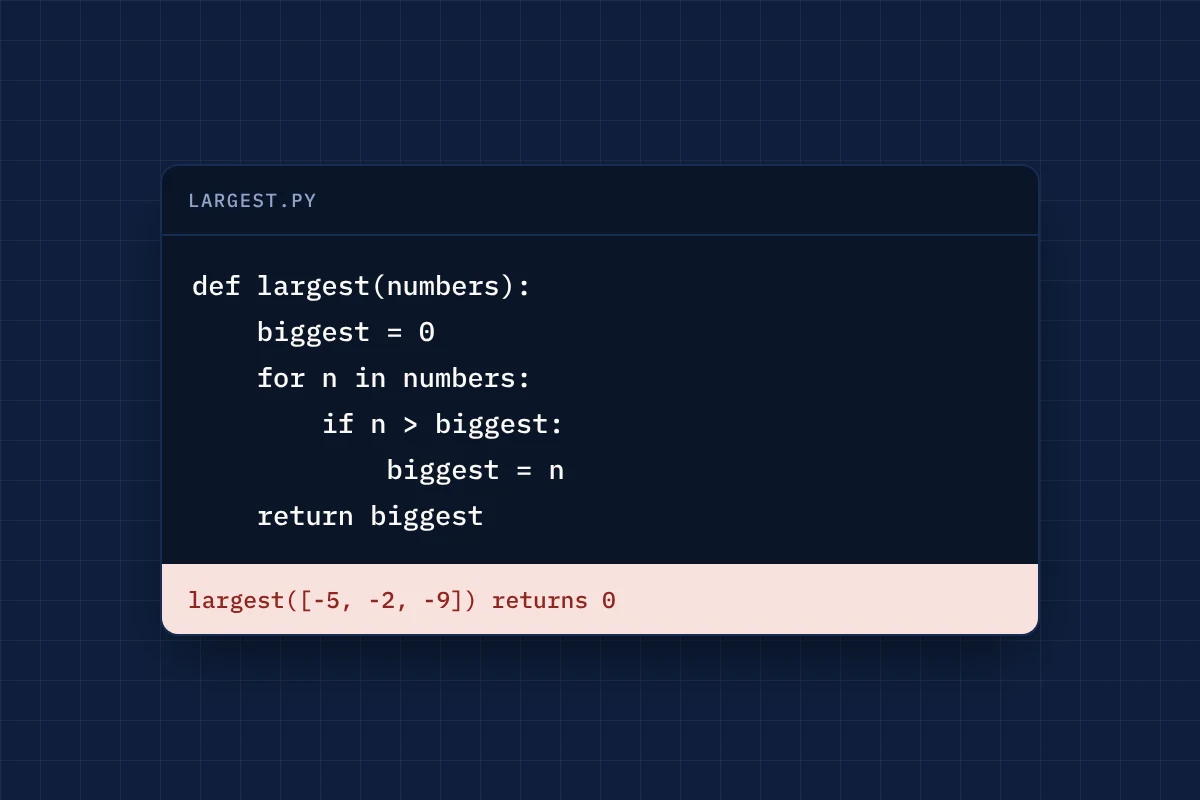
Here is how small the gap can be. Everyone understands the idea of finding the largest number in a list: look at each one and remember the biggest so far.
def largest(numbers):
    biggest = 0
    for n in numbers:
        if n > biggest:
            biggest = n
    return biggest

print(largest([-5, -2, -9]))def largest(numbers):
biggest = numbers[0]
for n in numbers:
if n > biggest:
biggest = n
return biggest
print(largest([-5, -2, -9]))The idea was right both times. The first version started the count at 0, and no negative number is bigger than 0. You only learn to see that kind of thing by getting it wrong a few times.
Three reasons it feels harder than it is
| It feels like | What is going on | What helps |
|---|---|---|
| “I made one tiny mistake and nothing works” | The computer is exact. A person would guess what you meant. | Run your code after every few lines |
| “I get errors constantly” | Everyone does. Errors are the normal feedback. | Read the last line of the error first |
| “I don’t know where to start” | Splitting a problem into steps is a skill of its own | Write the steps in plain words first |
The computer is exact. We left the colon off a loop and Python refused to run any of the file:
    for n in [1, 2, 3]
                      ^
SyntaxError: expected ':'
That is not a sign you are bad at this. Python’s own tutorial says such errors “are perhaps the most common kind of complaint you get while you are still learning Python”.
Errors are the feedback. Carnegie Mellon again: “Goal-directed practice coupled with targeted feedback enhances the quality of students’ learning.” In programming the feedback is the error message, and it arrives within a second. A red message means you just learned something. We wrote guides to the ones beginners meet first: IndexError, KeyError and ModuleNotFoundError.
Breaking a problem down is the real subject. Python’s documentation says a beginning course in Python “lets students concentrate on important programming skills such as problem decomposition and data type design”. Problem decomposition means turning one big task into small steps. That is the part with no syntax to memorize, and it is the part that takes longest.
What professionals do that beginners think is cheating
Beginners often believe real programmers write code from memory. They don’t.
In Stack Overflow’s 2026 developer survey, which had 30,903 responses, 82.7 percent of those who answered the question said they use online search tools to find guidance when they need an answer. Looking things up is the job. So is reading error messages, running code that is half finished, and deleting an attempt that did not work.
What professionals have that you don’t yet is years of the same loop: write, run, read the error, fix.
A routine for when you are stuck
- Say it in plain wordsWrite what the program should do as a list of steps, in English, before any code.
- Write the smallest pieceNot the whole assignment. One function, or five lines that print something.
- Run it nowDon’t wait until everything is written. Run after every few lines.
- Read the error from the bottomThe last line names the problem. The lines above say where.
- Change one thingThen run again. If you change three things at once, you won’t know which one mattered.
Timing matters as much as method. MIT tells students in its introductory Python course: “Your best strategy is to do the problem sets early before work starts to pile up.” A program that is stuck at 9 pm the night before it is due is a different problem from one that is stuck with four days to go.
How long until it stops feeling hard
Sooner than most students fear, and it comes in steps. Harvard’s introductory course asks its students to “solve ten problem sets”. By the end of a set like that, a loop no longer takes thought. We worked out the hours from real courses in how long it takes to learn Python.
It never becomes effortless, because the problems grow as you do. We went through the courses one by one in is computer science hard?
“Is it just me?”
No. Harvard says of its own introductory students: “Two thirds of CS50 students have never taken CS before.” It also tells them what to measure: “what ultimately matters in this course is not so much where you end up relative to your classmates but where you end up relative to yourself when you began.”
If the struggle has turned into dislike of the whole subject, read “I hate computer science” before you decide anything.
When an assignment won’t wait
Sometimes the deadline arrives before the skill does. Send us the assignment. A senior engineer writes or fixes it, tests it and explains the code line by line, so you can see how the idea became code. On our debug my code page, a single bug or error message is typically $45–$70, usually the same day.
Related: Python homework help, Java homework help and programming assignment help. If your code runs for you and fails the course grader, see why code works locally but fails the autograder.
Questions about learning to code
Is coding hard to learn?
It is hard at the start and gets easier with practice. The difficulty comes from three things: the computer is exact, writing code is a different skill from understanding an explanation, and errors are constant. Harvard reports that two thirds of the students in its introductory course have never taken computer science before, so starting from zero is normal.
Why do I understand the lecture but can’t write the code?
Because those are two skills. A lecture teaches you to follow an idea, and an assignment asks you to produce one. Carnegie Mellon’s teaching center says mastery needs component skills, practice integrating them, and knowing when to apply them. Only the first comes from listening.
Why is coding so hard at first?
Early on, everything is new at once: the syntax, the tools, and the habit of splitting a problem into steps. Python’s tutorial notes that syntax errors are perhaps the most common complaint while you are still learning. They fade with practice, and the problem-solving part is what remains.
Do professional programmers look things up?
Yes. In Stack Overflow’s 2026 developer survey, 82.7 percent of those who answered said they use online search tools to find guidance. Looking things up, reading error messages and trying again are normal parts of the work.
How do I get better at coding?
Write code often, in small pieces, and run it after every few lines. Start assignments early, read error messages from the last line up, and change one thing at a time. Practice with quick feedback is what builds the skill.
Is it normal to get errors all the time?
Yes. An error message is the feedback that tells you what to fix, and it arrives within a second. Getting many of them means you are running your code often, which is the right habit.
Sources
- Harvard CS50 syllabus, Fall 2025
- Carnegie Mellon University, Eberly Center: learning principles
- Python general FAQ and the Python tutorial: errors and exceptions
- MIT OpenCourseWare: 6.0001 syllabus
- Stack Overflow Developer Survey 2026
Upload the prompt and see a predicted budget in under a minute. A senior engineer confirms the final price.