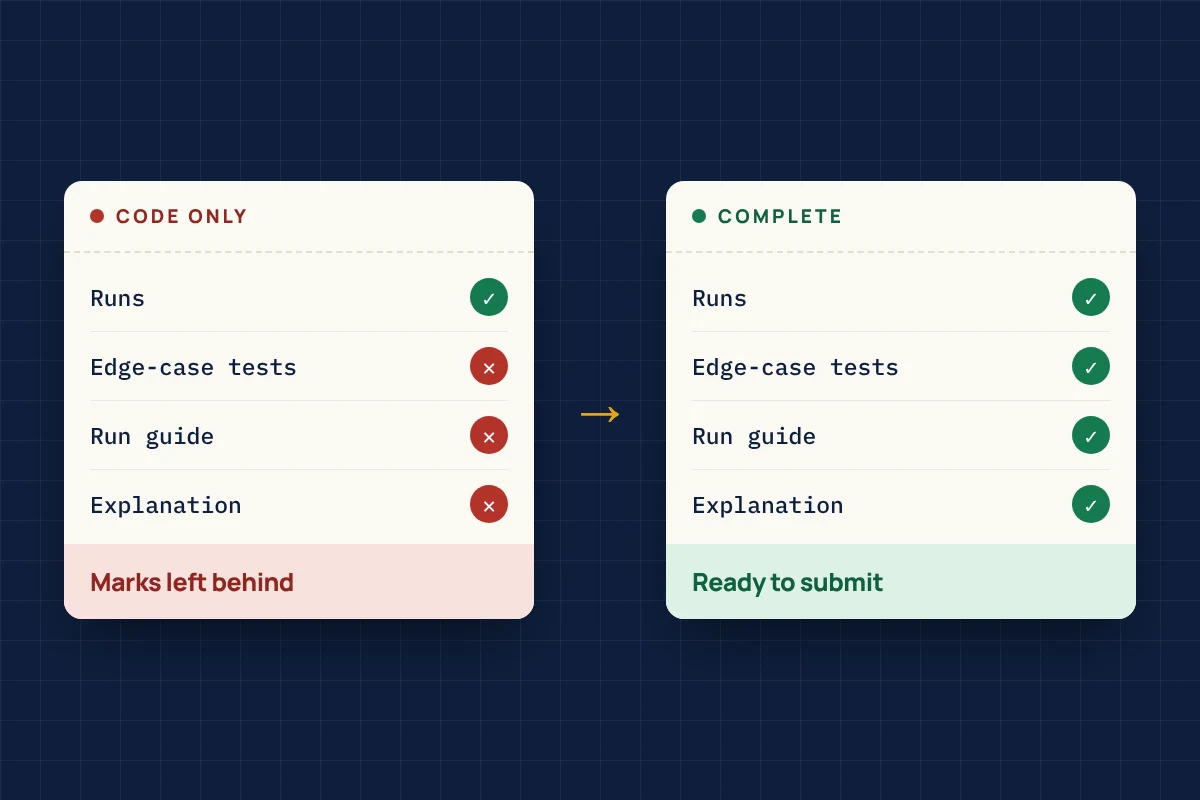
Students often think an assignment is finished when the output looks right. Graders are looking at more than that. This guide lists what a finished submission contains, with the standards quoted from course pages and from the tools’ own documentation.
We are the engineering team at DoMyProgrammingHomework.io. This is the standard we deliver to, and it is a fair checklist for work you write yourself.
What graders look at
Harvard’s CS50 states its formula: “Problem sets and the final project are evaluated along axes of correctness, design, and style,” with scores “ordinarily computed as 2 × correctness + 2 × design + 1 × style.” By that formula, correctness is two fifths of the mark.
Princeton’s algorithms course checks more than output as well. Its guidance says “Your programs should compile cleanly, with no errors or warnings.” It runs correctness, timing and memory tests, and “Failing any of these tests will likely lead to a deduction.” It runs a style checker. And it asks students to "Submit the readme.txt file."
So a complete solution is built for all of those readers: the autograder, the style checker and the person who opens the file.
The six parts
| Part | What it is | Who reads it |
|---|---|---|
| 1. Working code | Meets every requirement in the brief, with no errors or warnings | The autograder |
| 2. Tests | Cases that check the code, including the boundaries | You, then the grader |
| 3. Comments and docstrings | Why the code does what it does | The human grader |
| 4. A run guide | How to run it from a fresh download | Anyone who opens it |
| 5. Pinned dependencies | The exact libraries and versions | The grader’s machine |
| 6. An explanation | How it works and why it was built this way | You, before a viva or demo |
1. Code that meets the brief, exactly
Read the brief as a list and tick each item. File names, function names and output format count as requirements. An automatic grader compares them literally, which is the main reason code passes on a laptop and fails on submission. We wrote that up in why code works locally but fails the autograder.
2. Tests, with the edge cases
Python’s documentation defines the unit: “A test case is the individual unit of testing.” What matters is which cases you pick.
MIT’s software construction course gives the method. First, “we divide the input space into subdomains, each consisting of a set of inputs.” Then you look hardest at the edges, because “Bugs often occur at boundaries between subdomains.”
In practice that means testing the empty list, the single item, the largest allowed input, the negative number and the duplicate. In our experience, hidden tests go for the same cases.
import unittest

def largest(numbers):
    biggest = numbers[0]
    for n in numbers:
        if n > biggest:
            biggest = n
    return biggest

class TestLargest(unittest.TestCase):
    def test_all_negative(self):
        self.assertEqual(largest([-5, -2, -9]), -2)

    def test_single_item(self):
        self.assertEqual(largest([7]), 7)

if __name__ == "__main__":
    unittest.main()
3. Comments that explain why
The Python style guide is strict about this: “Comments that contradict the code are worse than no comments.” And: “Inline comments are unnecessary and in fact distracting if they state the obvious.”
A comment earns its place when it says something the code can’t: why this approach, what the tricky line guards against. For functions, Google’s Python style guide sets a clear bar: “A docstring should give enough information to write a call to the function without reading the function’s code.”
4. A run guide
GitHub’s documentation lists what a README usually covers, starting with “What the project does” and “How users can get started with the project”. For an assignment that means three things: what to install, the exact command to run, and what output to expect. A grader who can’t run your work in a minute may not try for ten.
5. Pinned dependencies
Code that needs a library needs the right version of it. Python’s tutorial explains: “Applications will sometimes need a specific version of a library”. The pip documentation gives the fix: “Requirements files are used to hold the result from pip freeze for the purpose of achieving Repeatable Installs.”
One file listing exact versions is the difference between “it runs” and “it runs on my machine”. A missing library on the grader’s side shows up as ModuleNotFoundError.
6. An explanation
This is the part students skip and the part that protects them. Some courses ask for it directly, in a readme or a report. Princeton’s course asks students to measure and report running time, noting “You must perform computational experiments because the leading coefficient in the tilde notation depends on your machine.”
Even where nobody asks, write half a page: the approach, the data structures chosen and why, the running time, and anything that does not work. If you can’t write it, you don’t yet understand your own submission, and a demo or oral question will find that out.
A pre-submission checklist
What we deliver
Since this is the standard we work to, here is what comes back with an order from us: the code, edge-case tests, a run guide, an explanation doc with likely viva questions, and a rubric checklist. Revisions are free for 14 days against your original instructions.
We publish typical prices for every kind of order in our price guide. For a quick comparison of services, including ours, see how to judge a programming homework help service.
Related: programming assignment help, code review for feedback on code you wrote yourself, and debug my code.
Questions students ask
What should a programming assignment submission include?
Working code that meets every requirement, tests that include edge cases, comments and docstrings, a run guide, a list of pinned library versions, and a short written explanation of the approach. Many courses grade design and style as well as correctness, so code alone is not a complete submission.
How are programming assignments graded?
It varies by course. Harvard’s CS50 evaluates problem sets on correctness, design and style, ordinarily computed as two times correctness plus two times design plus one times style. Princeton’s algorithms course runs correctness, timing and memory tests and a style checker.
What are edge cases in programming?
Inputs at the boundaries of what the program must handle: an empty list, a single item, the largest allowed value, a negative number or a duplicate. MIT’s software construction course teaches that bugs often occur at boundaries between subdomains, which is why tests should target them.
How many comments should my code have?
Enough to explain what the code cannot say itself. The Python style guide warns that inline comments are unnecessary and distracting if they state the obvious, and that comments which contradict the code are worse than none. Comment the reasons, not the steps.
What goes in a README for an assignment?
What the program does, what needs to be installed, the exact command to run it, and the output to expect. GitHub’s documentation lists what a project does and how users can get started among the things a README typically covers.
Why does my code need a requirements file?
So it runs the same way on the grader’s machine as on yours. The pip documentation describes requirements files as holding the result of pip freeze to achieve repeatable installs. Without one, a missing or different library version can break working code.
Sources
- Harvard CS50 syllabus, Fall 2025
- Princeton COS 226: assignment FAQ
- MIT 6.031 Software Construction: testing
- PEP 8: style guide for Python code and Google Python style guide
- Python unittest documentation and the Python tutorial: virtual environments and packages
- pip user guide: requirements files
- GitHub Docs: about READMEs
Upload the prompt and see a predicted budget in under a minute. A senior engineer confirms the final price.